WISP Impact Through Agility, Community Service
There are approximately 1,200 WISPs in America. For over 20 years, WISPs have delivered internet access through a variety of transmission technologies. As stewards of primarily their own private capital resources, they choose the right tool for the job, meaning they address every network deployment with the technology that will work best for the project at hand. This might mean optical fiber. Or in many cases it might be unlicensed, lightly licensed or licensed FW. Or it may require a hybrid of fiber and wireless technologies.
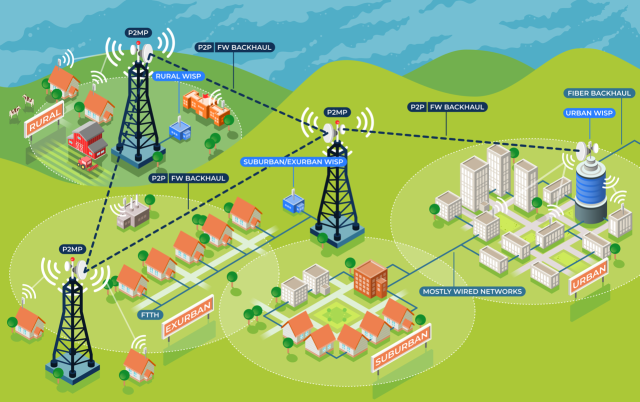
Example of a common WISP network, featuring fixed wireless and fiber connectivity.
Throughout their history, WISPs have focused on the raw mechanics of serving their diverse communities. This important work has collapsed the digital divide, helping to make reliable internet access virtually ubiquitous. Today, internet access is not just “nice-to-have,” but essential. Americans need it to stay safe, participate in our economy, and thrive.
As technology evolves and the communications marketplace becomes ever-more complex, competitive and converged, WISPs must be agile in meeting the evolving needs of their marketplaces, which go well beyond the raw mechanics of mere deployment and capacity.
__________
WISP Impact: WeLink
WeLink is one such provider meeting that challenge. The Utah based company uses innovative mesh-based wireless technology to serve customers in Baltimore, Dallas, Las Vegas, Los Angeles., New York, Phoenix, Tuscon and Washington, DC – many of whom live in marginalized and under-resourced areas of those cities.
Their motto – “Internet. For The People. By The People.” – says it all. The company sees itself as a firebrand, working to deliver the internet’s power and promise to urban communities that have long-lacked choice and affordable broadband options.

WeLink CEO, Luke Langford
As an example – in May 2024, WeLink partnered with Los Angeles County to bring reliable broadband to the under-resourced areas of East Los Angeles/Boyle Heights and South Los Angeles, areas neglected by Los Angeles’ persistent digital divide. For this program, WeLink offers a low-cost, $25 per-month internet plan to 50,000 qualified households, which will remain fixed until at least September 2027. And the service is blazingly fast, with speeds from 500 megabits per second (Mbps) to 2 gigabits per second (Gbps) – many times faster than the FCC’s defined broadband service baseline.
According to WeLink, the company was formed “to maximize the company’s social impact through partnerships that build on federal, state, and local broadband programs to deliver a digital future in which everybody thrives.”